Your Food chain in the ocean biome images are available. Food chain in the ocean biome are a topic that is being searched for and liked by netizens now. You can Download the Food chain in the ocean biome files here. Download all free photos and vectors.
If you’re searching for food chain in the ocean biome pictures information related to the food chain in the ocean biome interest, you have visit the ideal site. Our site frequently provides you with hints for viewing the maximum quality video and picture content, please kindly hunt and find more informative video content and graphics that match your interests.
Food Chain In The Ocean Biome. Shrimplike creatures eat the diatoms. Food web is a connection of multiple food chains. From the food chain, we get to know how organisms are connected with each other. Photosynthetic bacteria and algae are two of the many producers in the ocean.
 Coral Reef Food web poster Environmental Education From pinterest.com
Copepods feed on dinoflagellates and incorporate this energy into their own tissues. In general, food webs with low biodiversity are more vulnerable to changes than food webs with high biodiversity. Seals, walruses, sea lions, and dolphins are common examples of such sea animals. Food chain follows a single path whereas food web follows multiple paths. Food webs are built from food chains.all forms of life in the sea have the potential to become food for another life form. From the food chain, we get to know how organisms are connected with each other.
In some food webs, the removal of a plant species can negatively affect the entire food web, but the loss of one plant species that makes up only part of the diet of a herbivorous consumer may have little or no effect.
The animals that live here find their food in the ocean. A food chain is a way of showing how all living organisms in an environment get their energy. Sea mammals also contribute to the food chain by consuming fish. The marine biome is the largest in the world, and therefore contributes to intricate food webs. In times of need, they also hunt and kill the weak and the sick members of their own species. Made of interconnected food chains, food webs help us understand how changes to ecosystems — say, removing a top predator or adding nutrients — affect many different species, both directly and indirectly.
 Source: pinterest.com
This is evident in the diagram complementing this article. Organisms in a community are linked through what they eat and what eats them. Boost employee engagement in the remote workplace Sea mammals also contribute to the food chain by consuming fish. Phytoplankton and algae form the bases of aquatic food webs.
 Source: pinterest.com
Phytoplankton → herbivorous zooplankton → carnivorous zooplankton → filter feeder → predatory vertebrate Copepods feed on dinoflagellates and incorporate this energy into their own tissues. Food chains usually begin with plants or other small organisms and end with large carnivorous animals. Some of the top predators go onto the land to rest or reproduce, but the food that they eat is in the icy. A food chain is a single pathway connecting a producer with several levels of consumers.
 Source: pinterest.com
Phytoplankton → herbivorous zooplankton → carnivorous zooplankton → filter feeder → predatory vertebrate I compiled resources from the library and the internet to put together a study that my boys would enjoy. Sea mammals also contribute to the food chain by consuming fish. In a typical marine food chain, dinoflagellates convert energy from sunlight into food through photosynthesis and store it in their tissues. Summarize that microbes, including phytoplankton and bacteria, are the beginning and end, respectively, of ocean food chains and are therefore essential components of marine ecosystems.
 Source: pinterest.com
The answer has to do with trophic levels. Here is a sample food chain that can be found in a shallow ocean/bay: For an environment to remain healthy, the food chain must remain unbroken. Food webs are built from food chains.all forms of life in the sea have the potential to become food for another life form. Food chains usually begin with plants or other small organisms and end with large carnivorous animals.
 Source: pinterest.com
Phytoplankton will be significantly impacted by climate change, and this has a knock on effect to all animals in the food chain. Made of interconnected food chains, food webs help us understand how changes to ecosystems — say, removing a top predator or adding nutrients — affect many different species, both directly and indirectly. Phytoplankton and algae form the bases of aquatic food webs. Covering 71 percent of the earth’s surface, the ocean provides a magnificent variety of creatures. The study combines books, dvds, online videos, and activities.
 Source: pinterest.com
An ocean food chain shows how energy is passed from one organism, living thing, to another in the ocean. It covers one third of the earth�s surface, and makes up half of the world�s ocean area. Move your mouse over the picture and learn more about the different participants in this ocean food web. Shark and then fish continue down to small fish and then smallest poly and coral life. Food chains usually begin with plants or other small organisms and end with large carnivorous animals.
 Source: pinterest.com
Decomposers of the ocean is in the fifth place in an ecological food chain. The ocean has many intricate ecosystems that support many organisms and people. Plants on land and phytoplankton (algae) in the oceans. Food web is a connection of multiple food chains. In general, food webs with low biodiversity are more vulnerable to changes than food webs with high biodiversity.
 Source: pinterest.com
Boost employee engagement in the remote workplace Each of these creatures occupies a unique position on the food web, or trophic web, which is composed of producers, consumers, and decomposers. Move your mouse over the picture and learn more about the different participants in this ocean food web. A food chain is a single pathway connecting a producer with several levels of consumers. Covering 71 percent of the earth’s surface, the ocean provides a magnificent variety of creatures.
 Source: pinterest.com
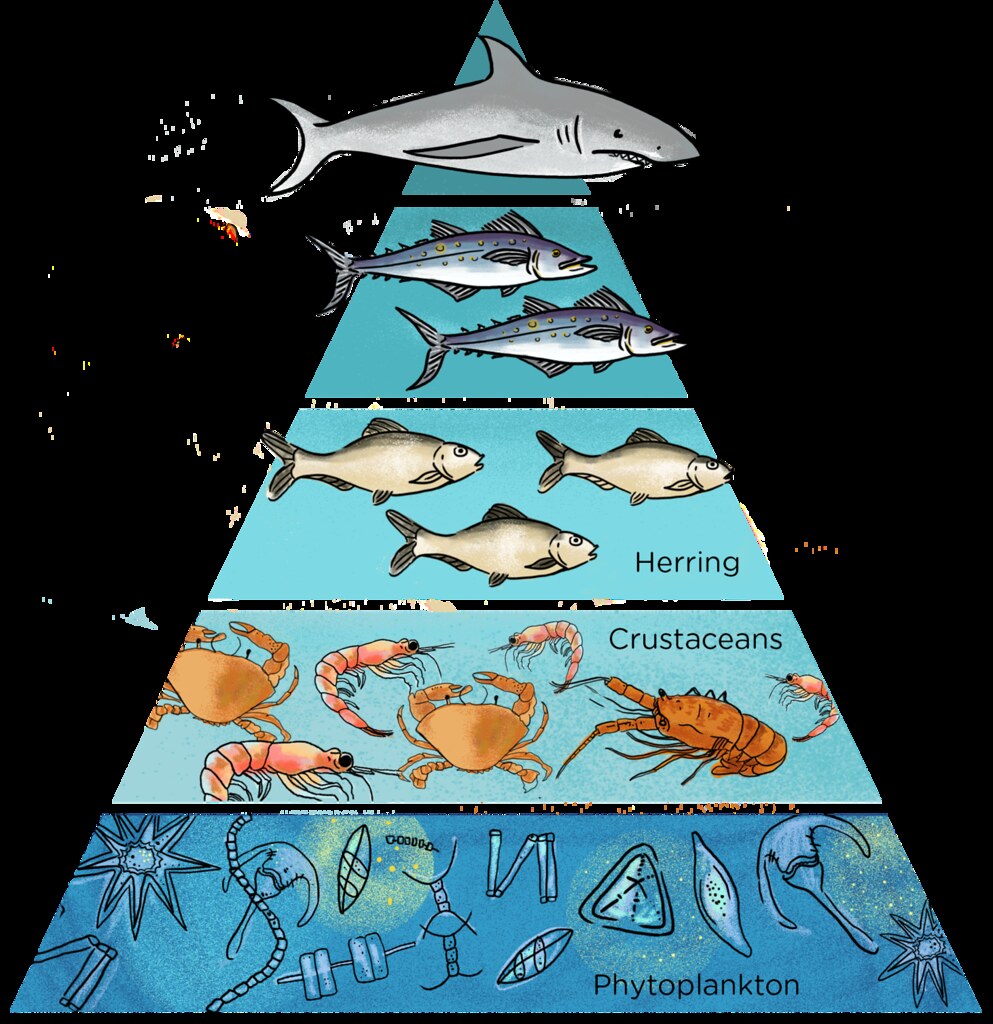
Zooplankton eat the phytoplankton.the fish eats the zoolankton.the seal eats the fish.the white shark eats the seal.in the ocean biome,the phytoplankton is the primary producer,the zooplankton is the primary consumer ,the fish is the secondary consumer ,the seal is the tertiary consumer ,and the white shark is the quarternary consumer Before we explain more about decomposers we must know first about the energy of pyramid. The change in cloud cover over the ocean has also changed the level of solar energy within the ocean. These organisms are called the producers, and they get their energy directly from sunlight and inorganic nutrients. Summarize that microbes, including phytoplankton and bacteria, are the beginning and end, respectively, of ocean food chains and are therefore essential components of marine ecosystems.
 Source: pinterest.com
Ask students to list the organisms in a terrestrial or aquatic food chain that they are. Each of these creatures occupies a unique position on the food web, or trophic web, which is composed of producers, consumers, and decomposers. Food chains are usually in a sequence, with an arrow used to show the flow of energy. The answer has to do with trophic levels. Photosynthetic bacteria and algae are two of the many producers in the ocean.
 Source: pinterest.com
It is home to the ring of fire, and the great barrier reef, as well as over 25,000 islands. On the ocean�s surface waters, microscopic animals—zooplankton, which include jellyfish. Covering 71 percent of the earth’s surface, the ocean provides a magnificent variety of creatures. Food chains usually begin with plants or other small organisms and end with large carnivorous animals. The change in cloud cover over the ocean has also changed the level of solar energy within the ocean.
 Source: pinterest.com
In times of need, they also hunt and kill the weak and the sick members of their own species. 3 different food chains. In times of need, they also hunt and kill the weak and the sick members of their own species. The most productive producers in the ocean are phytoplankton. In some food webs, the removal of a plant species can negatively affect the entire food web, but the loss of one plant species that makes up only part of the diet of a herbivorous consumer may have little or no effect.
 Source: pinterest.com
Food chains usually begin with plants or other small organisms and end with large carnivorous animals. This biome is an ocean shore environment. Food chain follows a single path whereas food web follows multiple paths. For natural reasons, the ocean biome is colder near the poles, but near the equator, it becomes warmer as the sun strikes the water directly, with a. The plan for our food chain, biome, and ecology study is now complete.
 Source: pinterest.com
Some of the top predators go onto the land to rest or reproduce, but the food that they eat is in the icy. Below are some living things that can fit into a food chain. In some food webs, the removal of a plant species can negatively affect the entire food web, but the loss of one plant species that makes up only part of the diet of a herbivorous consumer may have little or no effect. First chain second chain 1. An example of a simple food chain here is an example of another food chain in the tundra.
 Source: pinterest.com
I�m expecting this portion of our biology studies will tak Food webs describe who eats whom in an ecological community. Decomposers of the ocean is in the fifth place in an ecological food chain. Boost employee engagement in the remote workplace Phytoplankton will be significantly impacted by climate change, and this has a knock on effect to all animals in the food chain.
 Source: pinterest.com
For natural reasons, the ocean biome is colder near the poles, but near the equator, it becomes warmer as the sun strikes the water directly, with a. The animals that live here find their food in the ocean. In general, food webs with low biodiversity are more vulnerable to changes than food webs with high biodiversity. From the food chain, we get to know how organisms are connected with each other. Food chain follows a single path whereas food web follows multiple paths.
 Source: pinterest.com
Boiling hot deep sea vents are the primary energy source for an ocean biome. Made of interconnected food chains, food webs help us understand how changes to ecosystems — say, removing a top predator or adding nutrients — affect many different species, both directly and indirectly. This is evident in the diagram complementing this article. Each of these creatures occupies a unique position on the food web, or trophic web, which is composed of producers, consumers, and decomposers. Some of the plants in this first level of food chain are phytoplankton, seaweed, sea grass, and many other plants.
Source: pinterest.com
In the ocean, a food chain typically starts with energy from the sun powering phytoplankton, and follows a course such as: Zooplankton eat the phytoplankton.the fish eats the zoolankton.the seal eats the fish.the white shark eats the seal.in the ocean biome,the phytoplankton is the primary producer,the zooplankton is the primary consumer ,the fish is the secondary consumer ,the seal is the tertiary consumer ,and the white shark is the quarternary consumer The first chain begins with the largest predatory; The algae got its energy from the boiling hot deep sea vents. Decomposers of the ocean is in the fifth place in an ecological food chain.
This site is an open community for users to do submittion their favorite wallpapers on the internet, all images or pictures in this website are for personal wallpaper use only, it is stricly prohibited to use this wallpaper for commercial purposes, if you are the author and find this image is shared without your permission, please kindly raise a DMCA report to Us.
If you find this site beneficial, please support us by sharing this posts to your favorite social media accounts like Facebook, Instagram and so on or you can also bookmark this blog page with the title food chain in the ocean biome by using Ctrl + D for devices a laptop with a Windows operating system or Command + D for laptops with an Apple operating system. If you use a smartphone, you can also use the drawer menu of the browser you are using. Whether it’s a Windows, Mac, iOS or Android operating system, you will still be able to bookmark this website.


